
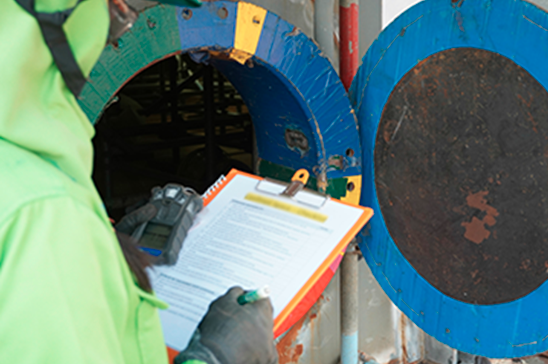
Confined Space vs. Permit-Required Confined Space: What Workers Should Know
The terms confined space and permit-required confined space are often used as though they mean the same thing. Under Occupational Safety and Health Administration (OSHA) rules, however, they describe two different levels of workplace risk.
A confined space is identified primarily by its size, access, and intended use. A permit-required confined space—sometimes called a permit space—is a confined space that also contains, or could contain, a serious hazard. That additional hazard changes how the space must be evaluated, controlled, entered, monitored, and prepared for emergencies.
Understanding the difference is important for workers in construction, utilities, manufacturing, plumbing, electrical work, maintenance, wastewater operations, and other trades. It can also prevent one of the most dangerous mistakes in confined-space work: entering a space before its hazards and rescue requirements have been properly evaluated.
What Is a Confined Space?
Under OSHA’s permit-required confined spaces standard for general industry, a confined space has all three of the following characteristics:
- It is large enough and arranged so that a worker can physically enter and perform assigned work.
- It has limited or restricted ways to enter or exit.
- It is not designed for workers to occupy continuously.
Examples may include tanks, silos, storage bins, process vessels, pits, vaults, manholes, sewers, pipelines, and some crawl spaces. A space is not automatically a confined space simply because it is small, uncomfortable, or enclosed. It must meet all three parts of OSHA’s definition.
OSHA also treats “entry” more broadly than many workers expect. Entry generally begins when any part of a worker’s body crosses the plane of the opening. A person does not need to climb completely inside for the entry requirements to become relevant.
What Makes a Confined Space Permit-Required?
A confined space becomes a permit-required confined space when it has one or more of the following characteristics:
- It contains or could contain a hazardous atmosphere.
- It contains material that could engulf a worker.
- Its internal shape could trap or asphyxiate a worker, such as inwardly converging walls or a floor that slopes toward a smaller cross-section.
- It contains another recognized serious safety or health hazard.
In this context, “permit-required” refers to the employer’s controlled entry process. It is not a building permit or a permit obtained from a local government. The entry permit documents the conditions, precautions, personnel, testing, communication methods, and rescue arrangements authorized for a specific entry.
Confined Space vs. Permit-Required Confined Space
| Question | Confined space | Permit-required confined space |
|---|---|---|
| Does it meet OSHA’s three physical criteria? | Yes | Yes |
| Does it contain or potentially contain a serious hazard? | Not necessarily | Yes—at least one permit-space hazard is present or possible |
| Is an OSHA permit-space entry program required? | Not solely because of its classification | Generally yes when employees will enter, unless a specific alternative procedure or lawful reclassification applies |
| Is an entry permit normally required? | No | Yes for entry under the full permit program |
| Are an attendant and entry supervisor normally part of the entry team? | Not based on confined-space classification alone | Yes for a standard permit entry |
| Must rescue arrangements be addressed before entry? | Based on the hazards and applicable rules | Yes as part of the permit-space program |
The critical point is that a confined space is not automatically safe because it is classified as “non-permit.” Employers must evaluate confined spaces, and the classification must be reconsidered if conditions or work activities introduce a serious hazard.
Hazards That Can Turn a Confined Space Into a Permit Space
Some hazards are already present in a space. Others develop because of the work being performed. Common examples include:
Hazardous atmospheres
A space may have too little or too much oxygen, flammable gases or vapors, combustible dust, or toxic contaminants. Hydrogen sulfide, carbon monoxide, solvent vapors, and other dangerous substances may accumulate without obvious warning. Workers should never rely on smell to determine whether an atmosphere is safe.
OSHA requires atmospheric testing and monitoring appropriate to the hazards. When testing permit spaces, the atmosphere is generally checked for oxygen first, then combustible gases and vapors, followed by toxic contaminants. The NIOSH Pocket Guide to Chemical Hazards is a useful reference for understanding exposure limits, symptoms, and protective recommendations for hundreds of workplace chemicals.
Engulfment hazards
Grain, sand, water, sludge, powders, or other flowing materials can surround, trap, crush, or suffocate an entrant. Material does not need to fill the entire space to create a fatal engulfment risk.
Entrapment and internal configuration
Inwardly converging walls, sloped floors, narrow passages, and tapered sections can trap a worker or restrict breathing. A person who becomes unconscious may also be extremely difficult to retrieve through a small opening.
Mechanical, electrical, thermal, and process hazards
Mixers, augers, conveyors, electrical equipment, pressurized lines, steam, extreme heat, falling objects, and unexpectedly introduced materials may create serious hazards. Isolation and lockout/tagout may be necessary before entry.
Hazards created by the work
Welding, cutting, coating, cleaning, or using fuel-powered equipment can change the atmosphere inside a space. A space that tested safely before work began may become hazardous once the task starts. That is why testing and monitoring requirements must be based on the work as well as the space itself.
General Industry and Construction Use Different OSHA Standards
The applicable rule depends on the type of work being performed—not simply the worker’s job title or the location of the space.
OSHA’s general industry permit-space requirements are found in 29 CFR 1910.146. Confined-space work performed as part of construction is generally addressed by OSHA’s Confined Spaces in Construction standard, 29 CFR 1926 Subpart AA.
The construction standard also assigns coordination duties among host employers, controlling contractors, and entry employers. This is especially important when multiple contractors are working at the same site or when one employer’s work could create a hazard for another employer’s entrants.
Other industry-specific standards may apply to shipyards, grain handling, telecommunications, electric power work, and certain other operations. State-plan jurisdictions may also have requirements that are at least as protective as federal OSHA and may differ in their details. Employers should confirm which rules apply before planning an entry.
What Must Happen Before Permit-Space Entry?
The exact procedure depends on the hazards and applicable standard, but a compliant permit-space program commonly includes the following steps.
1. Evaluate the workplace
The employer must determine whether confined spaces exist and whether any are permit-required. Workers who could be exposed must be informed of the location and danger of permit spaces, including through signs or another equally effective method.
2. Prevent unauthorized entry
Employees who are not authorized, trained, and assigned to the entry must be kept out. A warning sign alone does not replace barriers or other controls where unauthorized entry remains possible.
3. Identify and control every hazard
Hazards may need to be eliminated or controlled through isolation, lockout/tagout, line blanking or blocking, cleaning, purging, ventilation, guarding, personal protective equipment, or other measures.
4. Test the atmosphere
Atmospheric testing must be performed with properly calibrated equipment by someone qualified to use and interpret it. Testing should reflect the possibility that gases can collect at different levels within a space. Conditions may also need continuous monitoring during entry.
5. Complete and authorize the entry permit
Before entry begins, the entry supervisor verifies that required tests, procedures, equipment, and rescue provisions are in place. OSHA’s permit-space standard identifies information that must appear on the permit, including the space, purpose and duration of entry; authorized entrants; attendants; hazards; acceptable conditions; test results; control measures; communication procedures; rescue arrangements; and required equipment.
6. Establish communication and monitoring
Entrants must be able to communicate with the attendant. The attendant remains outside the permit space, monitors conditions and entrants, prevents unauthorized entry, orders evacuation when necessary, and summons rescue services. An attendant should not perform another duty that interferes with these responsibilities.
7. Prepare for rescue before entry
Calling 911 is not, by itself, a complete rescue plan. The employer must evaluate the rescue service’s ability to respond in time and perform the type of rescue the space may require. Retrieval systems should be used when required and when they will not increase the entrant’s risk.
Workers should never make an impulsive entry to rescue an unconscious coworker. An untrained would-be rescuer can quickly become another victim. OSHA’s permit-required confined spaces QuickCard provides a concise reminder of key entry hazards and precautions.
The Three Primary Permit-Space Roles
Workers should understand the responsibilities of the people involved in a permit entry.
Authorized entrant
The entrant must understand the hazards, properly use required equipment, maintain communication with the attendant, recognize warning signs, and leave immediately when ordered or when a prohibited condition is detected.
Attendant
The attendant stays outside the space and tracks who is inside. This person monitors the entry, communicates with entrants, keeps unauthorized people away, orders evacuation when required, and starts the designated emergency response process without entering the space.
Entry supervisor
The entry supervisor confirms that acceptable entry conditions exist, authorizes the permit, verifies that rescue services are available, removes unauthorized individuals, and terminates or cancels the entry when conditions require it.
One person may sometimes perform more than one role if the applicable standard allows it and that person can fully perform every assigned duty. Staffing should never be reduced in a way that prevents continuous monitoring or a timely response.
Can a Permit Space Be Reclassified?
In limited circumstances, an employer may reclassify a permit-required confined space as a non-permit space. Under the federal standards, reclassification generally depends on eliminating—not merely controlling—all permit-space hazards, and it is subject to specific documentation and procedural conditions.
If workers must enter the space to eliminate a hazard, that initial entry must be performed using the required permit-space procedures. A space with an actual or potential hazardous atmosphere cannot simply be reclassified while the atmospheric hazard remains.
Some entries involving only a controlled atmospheric hazard may qualify for alternative procedures when the employer satisfies every condition in the applicable standard. Ventilation alone should never be treated as an automatic exemption.
If a hazard develops after reclassification or during an alternative-procedure entry, workers must exit. The employer must reevaluate the space before anyone reenters.
What Training Do Workers Need?
OSHA requires training so employees involved in permit-space work have the knowledge and skills needed to perform their assigned duties safely. Training must occur before the employee is first assigned those duties, when assigned duties or permit-space operations change, and when the employer finds that a worker’s knowledge or use of procedures is inadequate.
Training must cover the worker’s actual role and workplace conditions. Depending on the assignment, that may include:
- Recognizing confined spaces and permit-space hazards
- Understanding entry permits and acceptable entry conditions
- Using atmospheric testing, ventilation, communication, retrieval, and personal protective equipment
- Performing entrant, attendant, or supervisor duties
- Following evacuation and emergency procedures
- Understanding the employer’s site-specific permit-space program
Workers and employers looking for introductory instruction can review M.E.P. Con. Ed.’s confined space training requirements courses. Available options include the Confined Space Hazards online course and the Confined Spaces: Construction Requirements course.
An online awareness course can strengthen hazard recognition, but it does not by itself replace an employer’s written program, site-specific instruction, equipment training, atmospheric-testing procedures, rescue preparation, or hands-on competency evaluation when those elements are required.
Employers developing broader safety education may also review available OSHA 10-Hour training courses and OSHA 30-Hour training courses. OSHA Outreach courses provide general hazard-awareness instruction; they do not replace training required by a specific OSHA standard.
Frequently Asked Questions
Is every tank or manhole a permit-required confined space?
No. Many tanks and manholes meet the basic definition of a confined space, but permit-required status depends on whether the space has or could have at least one permit-space hazard. Each space must be evaluated based on its actual and potential conditions.
Does a quick task still count as confined-space entry?
Yes. The duration of the task does not remove the requirements. Entry generally begins when any part of the body crosses the opening, even if the worker expects to be inside only briefly.
Can a worker enter if the atmosphere tested safe once?
Not necessarily. A safe initial reading does not address engulfment, mechanical, electrical, configuration, heat, or other hazards. Conditions can also change after work begins. The employer’s complete entry procedure and monitoring requirements still apply.
Does completing an online course make someone an authorized entrant?
Not automatically. The employer must assign the role and provide training appropriate to the worker’s duties, the workplace, the equipment, and the specific permit-space program. The employer must also ensure that the employee has acquired the required understanding and skills.
Can a coworker enter to perform a rescue?
Only workers who are designated, trained, equipped, and authorized for that rescue should enter. Other workers should follow the emergency plan, summon the assigned rescue service, and use non-entry retrieval procedures when required and appropriate.
Know the Space Before You Enter
The difference between a confined space and a permit-required confined space is not just terminology. It determines whether a formal permit program, defined entry roles, atmospheric testing, continuous communication, and planned rescue capabilities are required.
Workers should never enter based on appearance, familiarity, or the belief that a short task cannot be dangerous. Before crossing the opening, confirm that the space has been evaluated, the correct procedure is in place, the permit is authorized when required, and everyone understands how to respond if conditions change.
For additional training options, browse M.E.P. Con. Ed.’s complete selection of OSHA confined-space training courses.
This article provides general educational information and is not a substitute for the applicable OSHA standard, state requirements, an employer’s site-specific safety program, or advice from a qualified safety professional.